

Safe Vials
Glow 70mg
Glow 70mg
Couldn't load pickup availability
Strictly for laboratory research and development use only. Not for human, therapeutic, or diagnostic applications.
View full details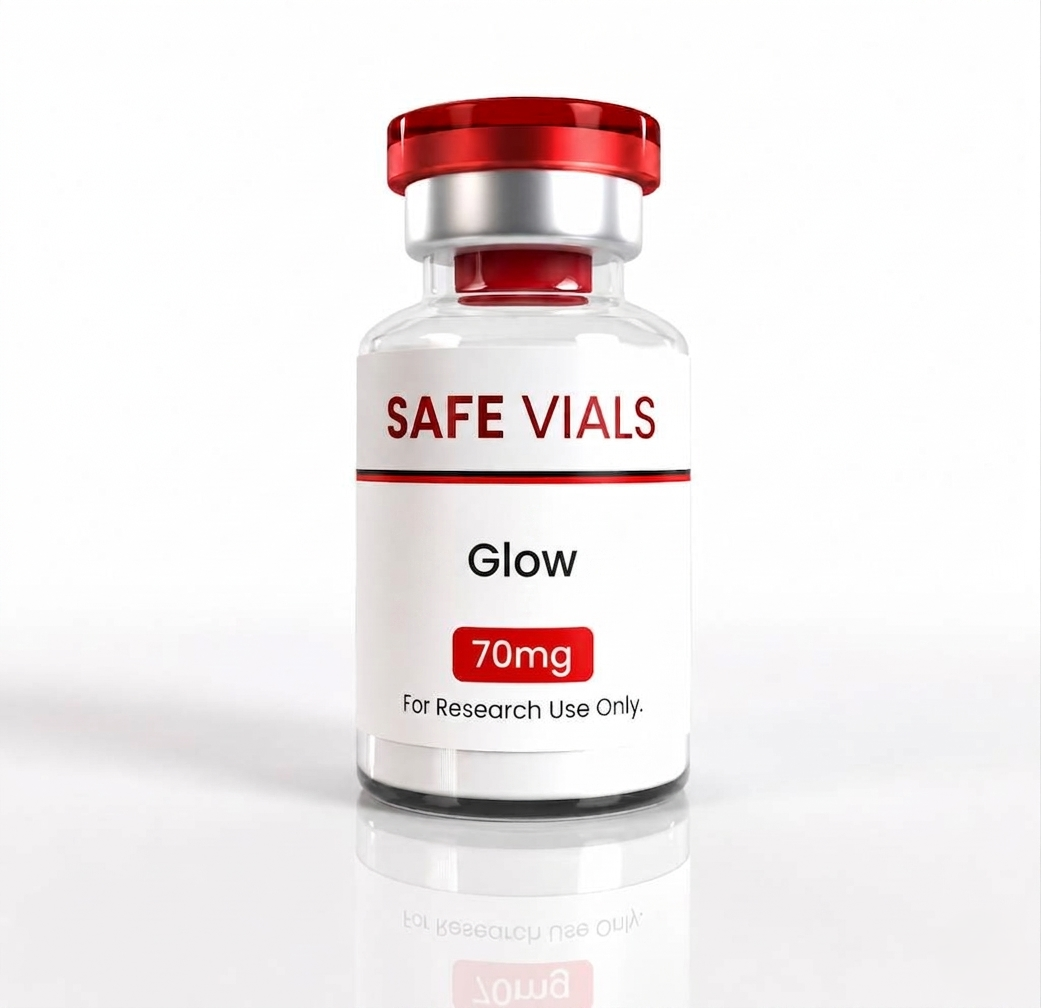
Description
Compound Information
-
Product Name: Safe Vials Glow (70mg)
-
Classification: Tri-Peptide Co-Lyophilized Research Blend
-
Formulation Ratio (per vial): 70mg Total Active Weight
-
GHK-Cu: 50mg
-
BPC-157: 10mg
-
TB-500: 10mg
-
-
Component Details:
-
GHK-Cu: Gly-His-Lys-Cu · CAS 89030-95-5 · 403.94 g/mol
-
BPC-157: Gly-Glu-Pro-Pro-Pro-Gly-Lys-Pro-Ala-Asp-Asp-Ala-Gly-Leu-Val · CAS 137525-51-0 · 1419.53 g/mol
-
TB-500: Ac-Leu-Lys-Lys-Thr-Glu-Thr-Gln · CAS 77591-33-4 · 889.02 g/mol
-
-
Visual Marker: Blue to blue-green lyophilized powder (indicative of authentic Cu²⁺ complexation)
Research Highlights
-
Convergent Multi-Pathway Signaling: Evaluates three distinct non-redundant channels—matrix synthesis, vascular growth signaling, and cytoskeletal dynamics—within a single experimental control.
-
Extracellular Matrix Regulation (GHK-Cu): Drives collagen synthesis and modulates metalloproteinase gene expression in tissue culture models.
-
Angiogenic Pathway Engagement (BPC-157): Promotes capillary tube formation, growth factor receptor upregulation, and endothelial proliferation.
-
Actin Sequestration & Cell Migration (TB-500): Utilizes the active LKKTETQ motif to bind G-actin monomers and direct cellular motility during wound-closure assays.
-
Fixed-Ratio Convenience: Pre-mixed and co-lyophilized to eliminate the concentration and volumetric variances introduced when combining separate single-component vials.
-
Analytical Purity Verification: Each individual peptide component is independently HPLC-verified (≥ 99% purity) prior to co-lyophilization.
Product Specifications
-
Physical Form: Co-lyophilized solid powder
-
Visual Appearance: Blue to blue-green cake/powder
-
Purity Level: ≥ 99% per component (HPLC Verified)
-
Solubility: Readily soluble in sterile water or bacteriostatic water
-
Storage Requirements:
-
Unopened (Lyophilized): Keep sealed and dry at -20°C for long-term storage (or 2–8°C for short-term handling). Shield from direct light to protect the copper-bound tripeptide.
-
Reconstituted Solution: Store under refrigeration at 2°C – 8°C. Aliquot working stock solutions to prevent structural degradation from repeated freeze-thaw cycles.
-
-
Usage Disclaimer: Strictly for In Vitro Laboratory Research and Development Use Only. Must be handled by qualified professionals. Not for human, therapeutic, or diagnostic applications.
Research Studies
Frequently Asked Questions
Are your peptides lab tested?
Yes, all our products are tested by third-party laboratories.
COAs are available per batch.
Why is my peptide not dissolving properly?
Some peptides dissolve slower than others.
Using bacteriostatic water or first adding a small amount of acetic acid can improve dissolution.
Why does my peptide look different?
Peptides can appear as powder, flakes, or a solid “puck”.
This is normal and caused by the freeze-drying process — it does not affect quality.
How should I store peptides?
- Long-term: freezer (-18 to -20°C)
- After mixing: refrigerator (2–8°C)
- Always keep away from light and heat
Are your products for human consumption?
No. All products are sold strictly for research purposes only.
They are not intended for human or animal use.
Do you offer refunds or reships?
We handle issues case-by-case.
If there is a problem with your order (damage, delivery issue), we will always work towards a solution including reshipment where appropriate.