

Safe Vials
NAD+ 500mg
NAD+ 500mg
Couldn't load pickup availability
Strictly for laboratory research and development use only. Not for human, therapeutic, or diagnostic applications.
View full details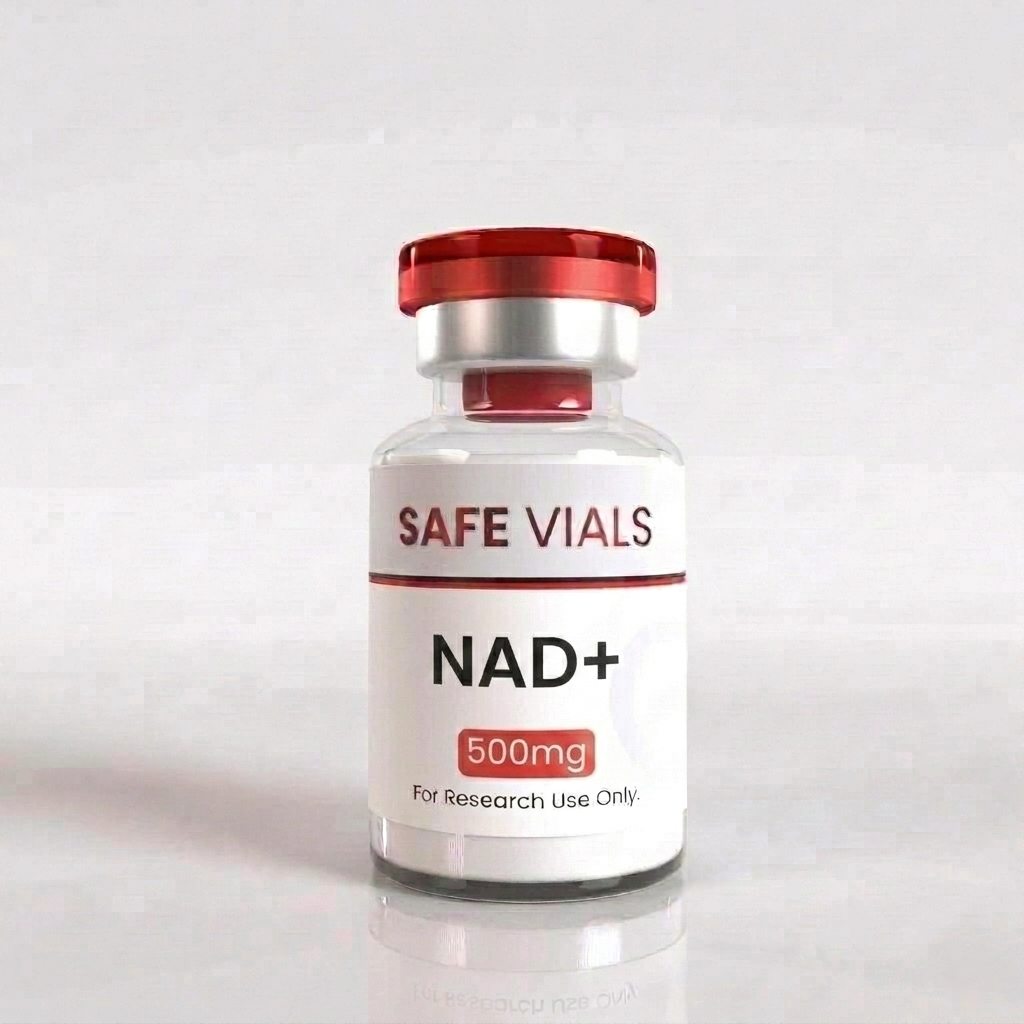
Description
Compound Information
-
Product Name: Safe Vials NAD+
-
Classification: Redox Coenzyme / Dinucleotide
-
CAS Registry Number: 53-84-9
-
Molecular Formula: C₂₁H₂₇N₇O₁₄P₂
-
Molecular Weight: 663.43 g/mol
-
Structure: Nicotinamide + Adenine, linked via two ribose–phosphate groups
-
Redox State: Oxidized form (NAD⁺; reduced form is NADH)
-
Synonyms: β-NAD, Nicotinamide Adenine Dinucleotide (oxidized)
Research Highlights
-
Central Electron Transport Carrier: Reversibly cycles between NAD⁺ and NADH to drive mitochondrial ATP production across core metabolic pathways.
-
Essential Sirtuin Substrate: Serves as an indispensable substrate consumed by sirtuins (SIRT1–7), making it a key readout for deacetylase activity and gene expression studies.
-
PARP-Mediated DNA Repair: Acts as a limiting cofactor during PARP enzyme activation in response to cellular genomic stress and repair protocols.
-
Mitochondrial Redox Standard: The NAD⁺/NADH ratio serves as a fundamental biomarker for cellular redox status and mitochondrial health in live-cell assays.
-
Dehydrogenase Assay Reagent: Functions as a standard cofactor in enzymatic assays tracking NADH formation spectrophotometrically at 340 nm.
-
Analytical Purity Verification: Independently verified via HPLC (≥ 99% purity) to eliminate contaminant-driven variability in kinetic assays.
Product Specifications
-
Physical Form: Solid lyophilized powder
-
Visual Appearance: White to off-white powder (hygroscopic nature)
-
Purity Level: ≥ 99% (HPLC Verified)
-
Solubility: Soluble in sterile water or bacteriostatic water (avoid alkaline buffers to prevent degradation)
-
Storage Requirements:
-
Unopened (Lyophilized): Keep tightly sealed and dry at -20°C for long-term storage (or 2–8°C for short-term handling). Protect from light and atmospheric moisture.
-
Reconstituted Solution: Store under refrigeration at 2°C – 8°C. Prepare fresh working stocks as needed; avoid long-term aqueous storage due to potential hydrolytic breakdown.
-
-
Usage Disclaimer: Strictly for In Vitro Laboratory Research and Development Use Only. Must be handled by qualified professionals. Not for human, therapeutic, or diagnostic applications.
Research Studies
Frequently Asked Questions
Are your peptides lab tested?
Yes, all our products are tested by third-party laboratories.
COAs are available per batch.
Why is my peptide not dissolving properly?
Some peptides dissolve slower than others.
Using bacteriostatic water or first adding a small amount of acetic acid can improve dissolution.
Why does my peptide look different?
Peptides can appear as powder, flakes, or a solid “puck”.
This is normal and caused by the freeze-drying process — it does not affect quality.
How should I store peptides?
- Long-term: freezer (-18 to -20°C)
- After mixing: refrigerator (2–8°C)
- Always keep away from light and heat
Are your products for human consumption?
No. All products are sold strictly for research purposes only.
They are not intended for human or animal use.
Do you offer refunds or reships?
We handle issues case-by-case.
If there is a problem with your order (damage, delivery issue), we will always work towards a solution including reshipment where appropriate.